
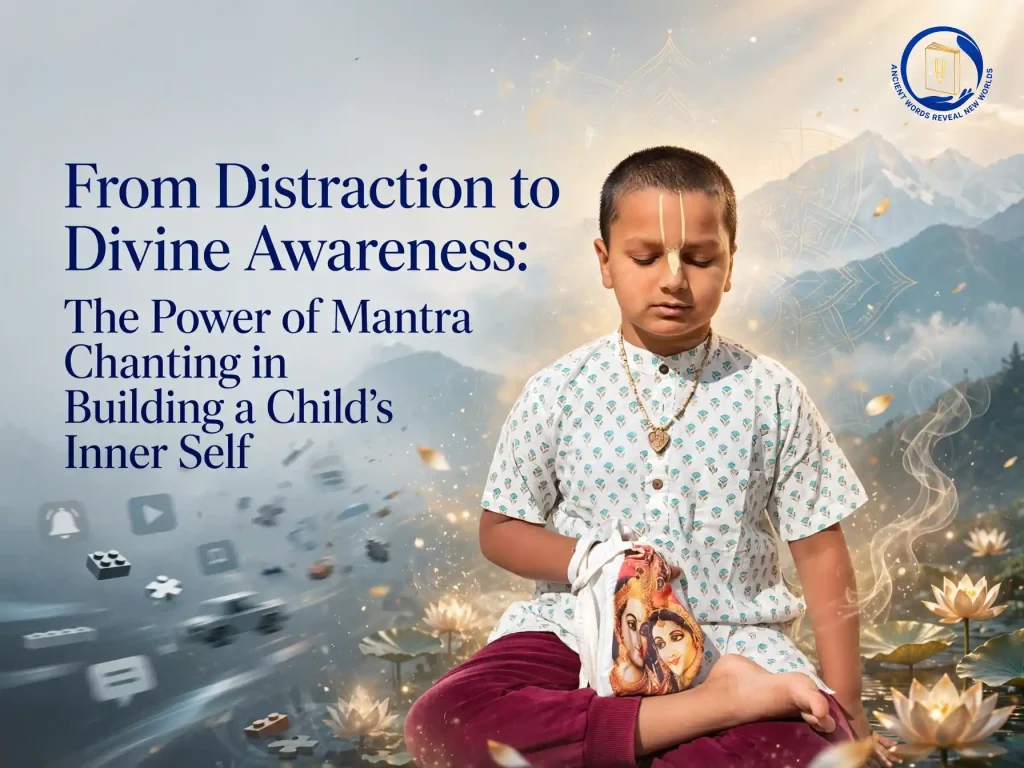
A child sitting quietly and repeating a mantra can appear to be doing something very simple. There is no textbook, no examination, and no outward sign that something important is happening. Yet within those few minutes, the child is learning to pause, to listen, to breathe, to repeat, and to notice when the mind wanders and then return. This article explores how this simple practice of sacred sound may influence attention, emotional wellbeing, daily habits, and spiritual development.
Quick Answer: What Does Mantra Chanting Offer a Child?
Mantra chanting offers a child a structured practice of attention. From a scientific view, it is a repeated cycle of hearing a sound, repeating it, noticing distraction, and returning. This cycle may support attention, emotional regulation, and self-discipline when combined with healthy lifestyle habits. From a Bhakti-yoga perspective presented by His Divine Grace A. C. Bhaktivedanta Swami Prabhupada, founder-acharya of the International Society for Krishna Consciousness (ISKCON), chanting is meant to cultivate awareness of the Supreme and revive one’s relationship with God. The practice becomes most meaningful when it is part of an integrated daily rhythm that includes sleep, nutrition, movement, family connection, and reflection.
The Deeper Purpose: More Than Calmness
For thousands of years, traditions of yoga and spirituality have regarded chanting and meditation as pathways toward inner awareness. Modern research has begun to examine related practices through psychology, neuroscience, education, and wellbeing.
The two perspectives are not identical, but they can be placed in meaningful conversation. Science asks: What changes can we observe? Spirituality asks: What does this practice mean for the person who is changing?
One useful philosophical framework comes from The Quest for Enlightenment by A. C. Bhaktivedanta Swami Prabhupada (1997), published by the Bhaktivedanta Book Trust. The book is a compilation of essays, conversations, and lectures addressing matter and spirit, yoga and meditation, and spiritual solutions to material problems. It presents yoga and meditation as part of the path toward spiritual knowledge and self-realization, with love of God as the ultimate goal.
This framework helps clarify purpose. The practice is not only intended to make a person calmer. Within the Bhakti-yoga tradition, its ultimate purpose is to cultivate awareness of the Divine.
The Mathematics of Yoga: A Spiritual Metaphor
The book offers a simple metaphor to explain this shift in awareness:
- GOD minus MY AWARENESS = SEPARATION. When awareness of God is absent, a person may experience spiritual disconnection.
- GOD plus MY AWARENESS = YOGA. Yoga here means connection, bringing consciousness back toward its relationship with the Divine.
There is a deeper point in this metaphor:
- GOD minus ME = GOD
- GOD plus ME = GOD
These are not mathematical equations in the scientific sense. They are a spiritual metaphor. God does not become incomplete because a person forgets, nor greater because a person remembers. God remains complete. The transformation takes place in the individual. The person moves from separation to connection, from forgetfulness to awareness, from distraction to attention, from material identification toward spiritual identity.
When understood this way, the mantra is not simply a sound to repeat. For the practitioner, it can become a reminder: I am more than my temporary thoughts, emotions, and circumstances. I have a spiritual relationship with the Divine.
What Happens When a Child Repeats a Mantra?
From a scientific perspective, careful language matters. Research on mantra-based meditation has reported potential benefits for mental health outcomes such as stress and anxiety.
What Research Shows
A 2022 systematic review and meta-analysis by Alvarez-Perez and colleagues found small to moderate effects across several psychological outcomes for mantra-based meditation, while also emphasizing differences in study quality and the need for further research.
Research involving children and mindfulness-based practices has also reported promising findings in areas such as cognitive and socio-emotional development, as summarized by Garcia-Rubio and colleagues in 2021. Studies such as the 2013 comparison of Gayatri Mantra and poem chanting on the Digit Letter Substitution Task examined immediate effects on an attention-related task in school students. A 2026 mixed-methods evaluation by Oswal, Jagtap, and Dasarwar looked at the effect of mantra meditation on attention and mental well-being in secondary school students.
However, the evidence is not strong enough to claim that chanting alone will make every child more focused, intelligent, or emotionally stable. A mantra should not be presented as a miracle treatment.
Concentration Means Learning to Return
Instead, mantra chanting may be understood as a structured practice of attention:
- The child hears a sound.
- The child repeats it.
- The mind wanders.
- The child returns to the sound.
That cycle may happen again and again. Perhaps this is one of the most valuable lessons a child can learn: concentration does not mean never becoming distracted. Concentration means learning how to return.
Mantra Chanting and Daily Habits: The Whole Lifestyle Matters
Consider two illustrative daily patterns. These are examples to show context, not scientific proof of causation.
Rama grows up in a family where morning prayer and mantra chanting are part of everyday life:
- 6:30 a.m. Wake up
- 6:40 a.m. Personal hygiene
- 6:50 a.m. Short prayer or mantra chanting
- 7:05 a.m. Breakfast with family
- 7:30 a.m. Prepare for school
- 8:00 a.m. to 3:00 p.m. School
- 4:00 p.m. Snack and outdoor activity
- 5:00 p.m. Homework
- 7:30 p.m. Family dinner
- 8:30 p.m. Reading, prayer, or quiet time
- 9:00 p.m. Sleep
Krishna may begin the day with a phone, television, or video game. Breakfast may be eaten quickly. Homework may be interrupted repeatedly by notifications. Bedtime may become later because of screen use.
We cannot scientifically conclude that any difference in habits is caused by mantra chanting alone. Rama’s parents may provide more structure. He may sleep earlier. His family may eat together. He may get more physical activity. School environment and temperament may also differ.
This is why a responsible discussion should not divide children into spiritual and non-spiritual categories and assume one group is automatically healthier. The more defensible question is whether a regular contemplative practice, when combined with supportive family and lifestyle habits, can contribute to a child’s development.
The Lifestyle Around Chanting
In many families, chanting does not exist in isolation. It may be part of a larger lifestyle involving:
- Regular waking and sleeping times
- Prayer or meditation
- Family meals and reduced distraction during meals
- Physical activity and outdoor play
- Reading and study
- Service to others
- Respectful communication and gratitude
- Community participation
- Time away from digital stimulation
When comparing children who practise spirituality with children who do not, researchers should ideally examine the whole lifestyle, rather than attributing every difference to mantra chanting. For example, if a child who chants also eats regular home-cooked meals and sleeps eight to ten hours, while another child regularly sleeps late and skips breakfast, it would be scientifically inaccurate to say chanting caused the difference. There may be several interacting factors.
For parents, the principle is similar. The goal should not be to create a child who mechanically chants for twenty minutes while spending the remaining day in unhealthy habits. The deeper goal is integration.
Food, Sleep, and Integration
A Conscious Relationship With Food
Spiritual traditions have long discussed food as part of disciplined living. Within different Indian traditions, families may follow vegetarian diets, fasting practices, food restrictions, offering food to God, or rituals of gratitude before eating. However, there is no single spiritual diet applicable to every child.
Mantra chanting itself does not automatically make a child eat healthily. Nutrition is influenced by family habits, culture, food availability, socioeconomic circumstances, preferences, and education. Yet spiritual family practices may encourage a more conscious relationship with food. A child may learn to:
- Pause before eating
- Express gratitude
- Eat with family
- Avoid unnecessary waste
- Understand food as something to be respected rather than consumed mindlessly
These habits can become part of a broader culture of awareness.
Why Sleep and Daily Rhythm Cannot Be Replaced
A spiritual practice cannot compensate for chronic sleep deprivation. If a child chants for ten minutes but stays awake until midnight watching videos, the family should not expect chanting to solve the consequences of an unhealthy routine.
A balanced childhood requires many foundations:
- Sleep for restoration
- Nutrition for growth and energy
- Movement for physical development
- Relationships for emotional security
- Learning for cognitive growth
- Emotional support for resilience
- Meaningful activity for purpose
- Opportunities for reflection for inner development
Mantra chanting can potentially become one part of this ecosystem. It should not replace the others.
Spiritual Children Are Not Automatically Better Children
This distinction deserves emphasis. A child who chants every morning is not automatically more compassionate than a child who does not chant. A child who follows a religious routine may still experience anger, jealousy, fear, or distraction. Likewise, a child who has never practised mantra meditation may be exceptionally kind, disciplined, thoughtful, and emotionally mature.
Spirituality is not a competition. The purpose of spiritual practice should not be to create a hierarchy between children. Instead, it can provide children with another language for understanding themselves.
Questions such as these are not always answered by examination scores:
- Who am I beyond my temporary roles?
- Why should I be kind?
- What is the purpose of life?
- Why do I experience happiness and suffering?
- What is my relationship with God?
From External Achievement to Inner Development
Modern childhood often revolves around measurable achievement. Grades, certificates, sports trophies, competitions, university admissions, and career ambitions matter. Yet there is another form of development that is harder to measure:
- Can the child sit quietly?
- Can the child tolerate frustration?
- Can the child listen without interrupting?
- Can the child recognise emotions?
- Can the child apologise and experience gratitude?
- Can the child distinguish between what they want and what they truly need?
- Can the child remember that identity is larger than academic performance?
These qualities may not appear on a school report card, but they influence the kind of adult a child eventually becomes. If education teaches a child what to know, contemplative practice can help teach a child how to be.
The Minus to Plus Journey: Building Inner Architecture
The spiritual journey of a child can be imagined as a movement from minus to plus. This does not mean the child is worthless without religion, or that non-practising children are minus. The metaphor describes the individual’s experience of awareness.
- Minus: I am completely absorbed in myself. Plus: I can become aware of something greater than myself.
- Minus: My immediate desire controls me. Plus: I can pause before acting.
- Minus: I am overwhelmed by every thought. Plus: I can observe my thoughts and return my attention.
- Minus: I define myself only by success and failure. Plus: I begin asking deeper questions about who I am.
- Minus: I feel separate and disconnected. Plus: I cultivate a relationship with the Divine.
In the Bhakti tradition represented by Srila Prabhupada, this movement ultimately points toward a loving relationship with Krishna and spiritual realization. The Quest for Enlightenment presents love of God as the ultimate goal of the spiritual path and discusses yoga as a means of developing consciousness of the Divine.
Over time, chanting becomes part of a child’s inner foundation building attention, self-control, gratitude, compassion, self-awareness, and remembrance of God. In the Bhakti tradition, it helps transform distraction into attention, isolation into connection, forgetfulness into remembrance, and outer success into inner meaning.
Science and Spirituality: Different Questions, Shared Respect
Science and spirituality approach the question from different directions. It can measure attention, stress, anxiety, Behavioural outcomes, and other observable variables. Spirituality addresses questions of meaning, identity, purpose, relationship with God, and ultimate reality. One should not be presented as a substitute for the other.
For example, science cannot declare that God plus me equals God is a scientific equation. It is a theological and philosophical metaphor. Likewise, a spiritual belief should not be presented as scientific proof that chanting cures anxiety or guarantees academic success. Keeping these boundaries clear makes the discussion stronger. It allows appreciation of both perspectives without confusing them.
A Five Minute Beginning for Parents
For parents who wish to introduce mantra chanting for children, the practice does not need to begin with long sessions. Five minutes may be enough.
- Choose a comfortable space. The child can sit comfortably in a quiet place with minimal distractions.
- Select a mantra appropriate to your tradition. The family can choose a mantra or prayer that holds meaning for them.
- Repeat gently. The sound can be repeated softly without pressure to achieve a particular mystical experience.
- Allow wandering and returning. If the child’s mind wanders, they can return. If they become restless, they can pause.
- Keep it invitational. An invitation such as Come, let us sit together for five minutes can be more powerful than a command based on guilt. Spirituality grows best through meaningful experience, loving example, and understanding.
If questions arise, parents can discuss them openly. The practice should ideally feel like an invitation rather than a punishment.
The Real Power of Mantra Chanting
Perhaps the deepest power of mantra chanting is not that a particular sound magically changes a child’s destiny. Its power may lie in what the practice repeatedly asks the child to do: Stop. Listen. Remember. Return. Connect.
Perhaps the deepest power of mantra chanting is not that a sound magically changes a child’s destiny. Its true power may be in what the practice gently teaches: stop, listen, remember, return, and connect.
Scientifically, this can support attention, calmness, and emotional balance. In Bhakti-yoga, it becomes a way of remembering our relationship with God. For a child, it can simply be a quiet moment away from pressure, competition, screens, and expectations. Just a child, a sound, a breath, and a moment of stillness.
Perhaps this is the deeper journey of yoga: from distraction to awareness, from forgetfulness to remembrance, and from feeling alone to feeling connected with the Divine.
That is perhaps the real mathematics of yoga: From separation to connection. From forgetfulness to divine awareness. From I am alone to I am in relationship with the Divine. God does not become more complete because we remember Him. We become more aware of the completeness that was always there.
Conclusion
Mantra chanting should neither be dismissed as merely an ancient ritual nor exaggerated as a guaranteed scientific solution to every problem children face. The evidence surrounding meditation and mantra-based practices is promising, particularly in areas such as stress, attention, and wellbeing, but research involving children remains developing and requires careful interpretation.
At the same time, spiritual traditions offer a much older question: What kind of human being are we trying to help a child become? The ultimate value of mantra chanting may therefore lie not simply in the number of times a child repeats a sacred name. It may lie in the habits formed around that repetition: attention, patience, discipline, gratitude, self-reflection, compassion, and connection. For those who follow the teachings of Srila Prabhupada, the journey goes even deeper: beyond temporary identity toward self-realization and loving awareness of the Divine. That is why a few minutes of chanting may be small in time but potentially profound in meaning.
Frequently Asked Questions
What is mantra chanting for children?
Mantra chanting for children is a simple practice of repeating a sacred sound or prayer for a few minutes. The child sits quietly, repeats the sound, and gently returns attention when the mind wanders. It is used as a practice of attention and reflection, and within Bhakti-yoga, as a way to cultivate awareness of God.
Does mantra chanting make children more focused?
Research on mantra-based meditation has reported small to moderate effects on psychological outcomes such as stress and anxiety in general populations, but study quality varies and more research is needed. For children, mindfulness-based practices show promising findings for cognitive and socio-emotional development, but evidence is not strong enough to claim chanting alone will make every child more focused. It is best understood as one part of a healthy routine.
How long should a child chant each day?
A short, consistent practice is often enough to begin. Many families start with five minutes of sitting comfortably and repeating a mantra gently. The emphasis should be on invitation, regularity, and understanding rather than length or pressure.
Is mantra chanting a religious ritual only?
In the Bhakti-yoga tradition, chanting is a spiritual practice meant to revive awareness of the Supreme and cultivate love of God, as described in The Quest for Enlightenment. From a secular perspective, similar practices are studied as structured attention exercises. Both perspectives can be respected without confusing a theological metaphor with a scientific claim.
Can mantra chanting replace sleep, nutrition, or exercise?
No. A balanced childhood requires sleep, nutrition, movement, relationships, learning, emotional support, and opportunities for reflection. Mantra chanting can be one part of this ecosystem, but it should not replace other foundations such as eight to ten hours of sleep, regular meals, physical activity, and family connection.
References
Alvarez-Perez, Y., et al. (2022). Effectiveness of Mantra-Based Meditation on Mental Health: A Systematic Review and Meta-Analysis. International Journal of Environmental Research and Public Health, 19(6), 3380.
Bhaktivedanta Swami Prabhupada, A. C. (1997). The Quest for Enlightenment. Los Angeles: The Bhaktivedanta Book Trust.
Garcia-Rubio, C., et al. (2021). Exploring the Effects of Meditation Techniques Used by Mindfulness-Based Programs on the Cognitive, Social-Emotional, and Academic Skills of Children: A Systematic Review.
Oswal, A., Jagtap, S., & Dasarwar, P. (2026). Effect of anapana meditation on attention and mental well-being in secondary school students: a mixed-methods evaluation. Frontiers in Public Health.
Comparison of Effect of Gayatri Mantra and Poem Chanting on Digit Letter Substitution Task (2013).
Visit Our Recommended Websites
Explore more reflections and writings: Bikash Bolakhe Portfolio and Blog Articles